Cat tail language: what your cat's tail is saying
Cat tail language explained: what an upright, curled, puffed, tucked, quivering or swishing tail means, and how to read the tail with ears and posture.
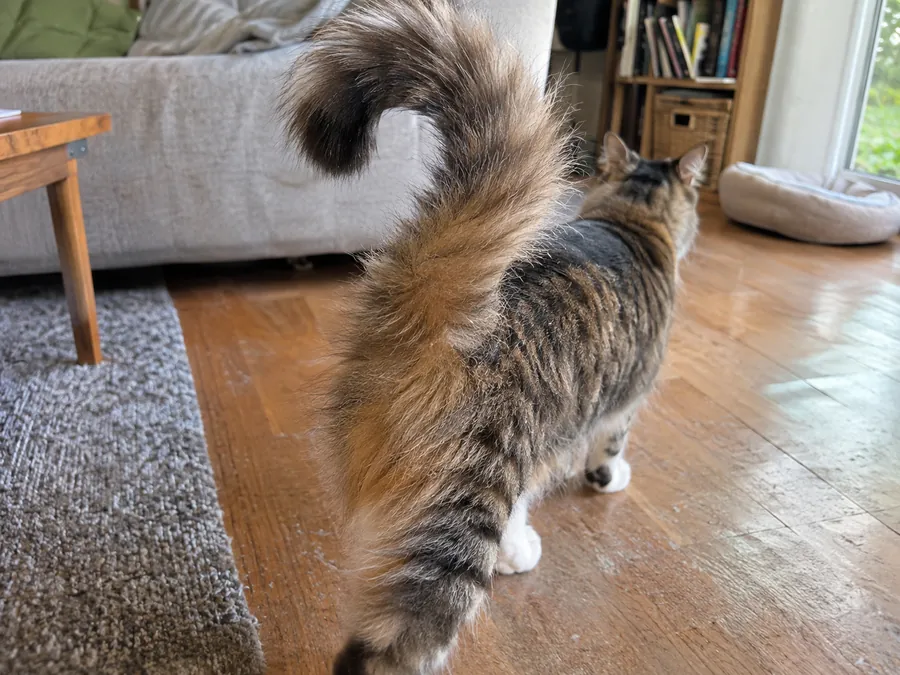
A cat’s tail is its mood flag. A tail held straight up usually means a happy, confident cat, a tucked tail means fear or stress, and a lashing tail means agitation, so the position, speed and shape of the tail tell you a lot about what your cat feels right now.
Below are the main tail positions, how to read them with the rest of the body, and what to do when the tail says “back off”.
The most common tail positions
Cats Protection describes a set of tail signals that most cat owners will recognize. Here they are side by side.
| Tail | Usual meaning |
|---|---|
| Straight up | Happy and confident |
| Up with a curve at the tip | Friendly greeting, glad to see you |
| Straight up and quivering | Excitement, or sometimes stress |
| Puffed up | Scared or threatened |
| Tucked under the body | Scared or stressed |
| Wrapped around you or another cat | Affection |
| Slow side-to-side movement | Undecided, or about to pounce |
| Quick side-to-side lashing | Angry or upset |
| Twitching or flicking | Agitated |
Treat the table as a starting point. The same tail can mean different things depending on the ears, eyes and situation.
Tail up: friendly and confident
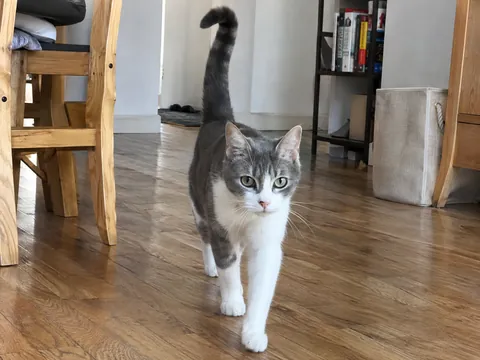
Cats Protection says a tail pointing straight up means your cat is feeling happy and confident, and that a tail up with a slight curve at the tip is a greeting. If your cat trots toward you with a raised, curled tail, you are being welcomed. A tail wrapped around you or another cat is affection, which Cats Protection compares to a hug. You may see it when your cat sits beside you or winds around your legs.
The RSPCA describes the same picture for a relaxed cat: loose body, soft eyes, tail straight up, sometimes curled at the tip. For more signs of a content cat, see how to tell if your cat is happy.
Quivering tail: excitement or stress
A tail held straight up and shaking can look dramatic. Cats Protection says it can signal excitement, but it can also be a sign of stress when a cat is spraying or fake spraying.
How to tell the difference:
- Excitement: the quiver appears when you arrive, a meal is coming or a favorite person walks in, and the cat is loose and friendly.
- Stress or marking: the cat backs up to a vertical surface, treads with its back feet or sprays. See your vet if you notice this, because medical problems and stress can both play a role.
Puffed or tucked tail: scared or threatened
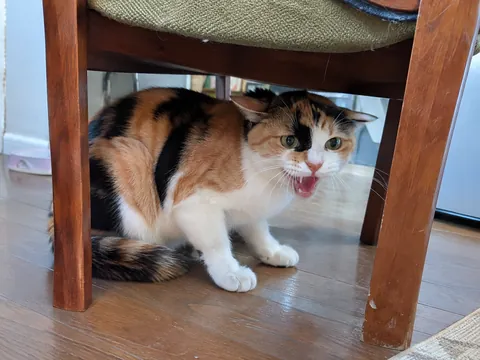
When the whole tail puffs up, the cat is scared or threatened and is trying to look bigger. The Humane Society pairs a frightened or angry cat with an arched back and fur standing up.
If you see this, do not try to comfort or pick up the cat. The ASPCA’s rule of thumb for cats in defensive postures is not to touch, reassure or punish them. Let the cat find a quiet spot.
A tail tucked underneath the body or between the back legs is a sign of fear or stress. International Cat Care says a tail tucked between the back legs is often a sign that a cat is anxious or fearful. The RSPCA describes a worried cat with a tail pressed tight to the body, a crouched, tense body and flat ears.
Common triggers are a new person, a loud noise, a visit to the vet or an unfamiliar room. Give the cat a hiding place and some time.
Slow sway, fast lash and twitching
Tail movement tells you how intense the feeling is.
- Slow side-to-side: Cats Protection reads this as indecision or readiness to pounce. International Cat Care says a tail held out and moving slowly side to side across the body may signal frustration.
- Quick lashing: Cats Protection links a tail quickly wagging side to side with anger. The Humane Society puts it simply: the faster the tail, the angrier the cat.
- Twitching or flicking: a sign of agitation. The ASPCA lists twitching or flipping the tail among the early signs that a cat wants you to stop petting.
If your cat is playing, a lashing tail can be part of the hunt. If you are just stroking the cat, a lashing tail is a request to stop.
Tail signals in everyday situations
A few common moments show how this works in practice.
- You come home and the tail shoots up: a greeting. Say hello and let the cat approach you rather than scooping it up.
- You are petting and the tail starts flicking: the early sign that your cat has had enough. Stop before the ears flatten, because the ASPCA lists tail twitching among the first signs a cat wants you to stop.
- A new cat or visitor arrives and the tail puffs or tucks: the cat feels unsafe. Keep the introduction slow and let the cat watch from a distance or a high spot.
- The tail sways slowly while the cat stares at a toy or window: hunting mode. This is a good time for a play session with a wand toy.
- The tail is low and tucked after a vet trip or a loud event: stress. Leave water, food and a hiding place, and avoid handling the cat until it settles.
Read the tail with the rest of the body
The tail is one clue among several. The ears, pupils, whiskers and posture should agree with it. Our pillar guide to cat body language shows how to combine them, and why your cat hisses at you covers what to do when the signals escalate.
A practical routine:
- Check the tail position first, then the speed of any movement.
- Look at the ears and pupils. Flat ears with a lashing tail mean back off.
- Look at the body. A relaxed body means the tail message is probably friendly.
- Adjust: stop petting, slow down, or give space.
If you want to experiment with your cat’s attention, the free laser game for cats in your browser gives you a chance to watch the tail during play.
When to call your vet
Behavior is usually mood, but a few tail changes deserve a call. Contact your vet if the tail suddenly hangs limp or is held at an odd angle, if your cat guards it or reacts when it is touched, if you see swelling or wounds, or if quivering and marking appear together with litter box problems or other sudden changes. The VCA notes that growling, hissing or hiding can also signal pain, so a new pattern is worth mentioning.
Sources
- Cats Protection — Cat tail meanings
- International Cat Care — Cat communication
- Humane World for Animals — Understanding cat behavior and feline language
- RSPCA — Cat body language
- ASPCA — Aggression in Cats
- VCA Animal Hospitals — How do I know if my cat is in pain?
Cat Translator is an entertainment app. This article is general information, not veterinary advice. If your cat's behavior changes suddenly, talk to your vet.