Why does my cat hiss at me?
Why does my cat hiss at me? A hiss is a warning from a scared, stressed or sore cat. Learn the common causes, what to do in the moment, and when to see a vet.
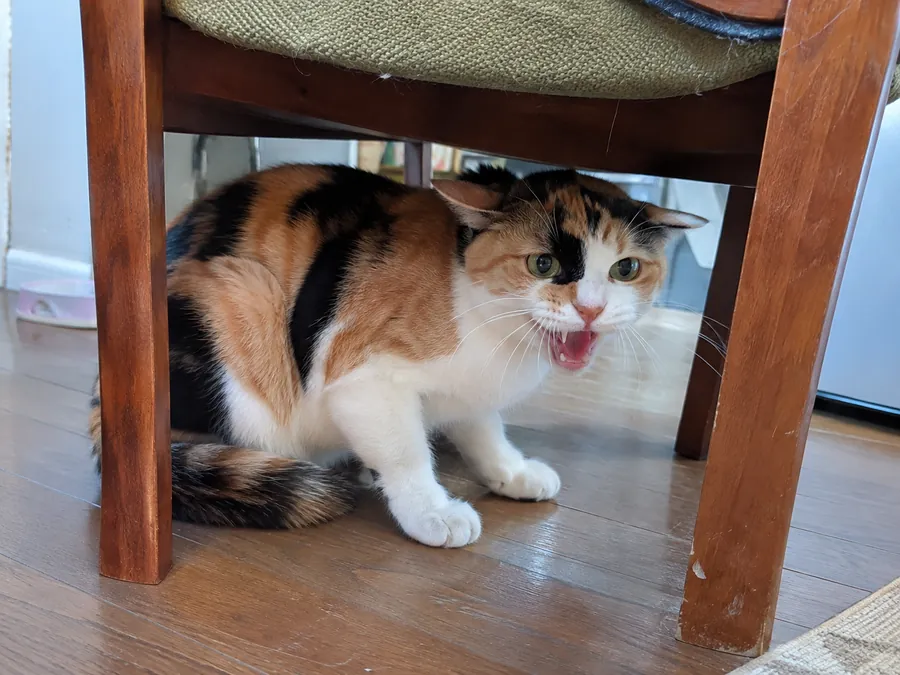
A hiss is a warning. Your cat is telling you to back off because it feels scared, threatened, annoyed or sore, and it would rather scare you away than fight. The fastest fix is to stop what you are doing, give the cat room and work out what triggered it.
This guide covers the common reasons cats hiss, how to read the body language that goes with it, what to do in the moment and when a vet visit is a good idea.
What a hiss means
Cats Protection says that hissing and spitting are defensive behaviors, and that a hissing cat is warning you and may be about to scratch or bite. VCA puts it plainly: hissing is a sign to back off. The Humane Society groups growling, hissing and spitting together as the sounds of a cat who is annoyed, frightened, angry or defensive, and advises leaving that cat alone.
The ASPCA lists open-mouthed hissing or spitting among defensive postures. In other words, the cat is trying to protect itself, not to start a fight.
Common reasons your cat hisses at you
- Fear. A new person, a loud noise, a carrier or an unfamiliar room can all frighten a cat. The ASPCA says fear aggression can occur when a cat perceives a threat and escalates if it cannot escape.
- Unwanted touch. Being picked up, petted too long or touched somewhere it dislikes. The ASPCA lists early signs like turning the head toward your hand and twitching the tail.
- Overstimulation during play. A cat in a high-energy chase may hiss when play gets too rough.
- Pain. The VCA lists growling or hissing when approached by family members as a possible sign of pain, along with hiding and withdrawing.
- Other animals. Between pets, a hiss means “keep your distance,” and it is common when a new cat, kitten or dog arrives.
- A new baby, guest or change at home. Changes in routine can make a cat feel unsafe.
Read the body that goes with the hiss
A hiss rarely comes alone. Look for these signals together:
- Ears flattened sideways or backward on the head
- Eyes wide with pupils partly or fully dilated
- Body crouched, arched or low, with fur standing on end
- Tail puffed, tucked or thrashing
- Mouth open with teeth showing
The ASPCA lists open-mouthed hissing or spitting, flattened ears and wide, dilated pupils as defensive postures. For the full picture, see our guide to cat body language and the one on cat tail language.
What to do when your cat hisses
The ASPCA’s rule of thumb is not to touch, reassure or punish a cat showing these postures. Often the best response is to avoid the cat until it calms down.
- Freeze, then back away slowly. Do not stare, shout or reach.
- Leave an exit. Cats escalate when they feel cornered.
- Let the cat retreat to a quiet room or a high place.
- Do not punish. It teaches fear, not manners.
- Wait. Give the cat time to settle before you approach. Cats Protection suggests giving them time to cool off before you stroke them or pick them up.
- Find the trigger. Think about what happened just before: a sound, a new smell, a hand movement.
Never try to break up a fight with your hands. The ASPCA says it is never a good idea. Cats Protection suggests distracting them with a toy or a loud noise instead.
Hiss, growl, spit: how they differ
These sounds sit on the same ladder of warnings. The VCA says a growling cat does not want to be messed with, and that carrying on may lead to hissing, spitting, scratching or biting. So a growl usually comes first, a hiss is a louder, more urgent version, and a spit is the hiss with a burst of air behind it.
That ladder is useful to you. If you catch the early signs, such as a flicking tail, flattened ears or a low growl, you can stop before the cat reaches the hiss. Cats that are punished for growling or hissing may learn to skip the warnings, which makes them harder to read later. Treat every warning as helpful information.
If your cat hisses at another pet or a new kitten
Hissing between household animals is normal in the first days of an introduction, and it is not a sign that the match will fail. What helps:
- Keep the newcomer in a separate room at first, with its own food, water, litter box and hiding spots.
- Let the animals smell each other’s bedding before they meet face to face.
- Make early meetings short and calm, ideally with a baby gate or a cracked door between them.
- Reward calm behavior with treats or play at a distance.
- Do not force contact or hold a hissing cat toward the other animal.
If hissing turns into chasing or fights, separate them calmly using a toy or a loud noise, never your hands, and ask your vet or a behaviorist for help.
How to reduce hissing over time
Most hissing fades when the cat feels safer.
- Give your cat hiding places and high perches in each room.
- Learn your cat’s stop signals when petting, such as a flicking tail, and quit before it reacts.
- Introduce new people or pets gradually, at the cat’s pace.
- Keep routines predictable.
- Offer play with a wand toy so energy has an outlet. A calm session on the free laser game for cats can help too.
If your cat’s hissing is directed at you in a way that feels sudden, it may be worth reading why your cat bites you when you pet her, which explains the same warning signs.
When to call your vet
Hissing at someone the cat usually likes, especially if it is new, can point to pain or illness. The ASPCA says a medical workup is essential for all aggressive cats, and that painful conditions such as arthritis, dental pain and abscesses from fighting are among the possible causes.
Call your vet if:
- The hissing started suddenly and the cat is usually friendly.
- Your cat hisses when you touch a particular spot.
- The cat is hiding, eating or drinking less, grooming differently or having litter box accidents. The VCA lists these among signs that may indicate pain.
- Hissing leads to biting or scratching that you cannot manage.
Your vet can rule out a medical cause and may refer you to a behaviorist.
Sources
- VCA Animal Hospitals — Meaning of different cat sounds
- Cats Protection — How to speak cat: why do cats meow?
- ASPCA — Aggression in Cats
- Humane World for Animals — Understanding cat behavior and feline language
- Cats Protection — Cats and fighting
- VCA Animal Hospitals — How do I know if my cat is in pain?
Cat Translator is an entertainment app. This article is general information, not veterinary advice. If your cat's behavior changes suddenly, talk to your vet.