Cat body language: how to read your cat
Learn to read cat body language: what ears, eyes, tail, whiskers, posture and sounds mean, how to combine the signals, and when to give your cat space.
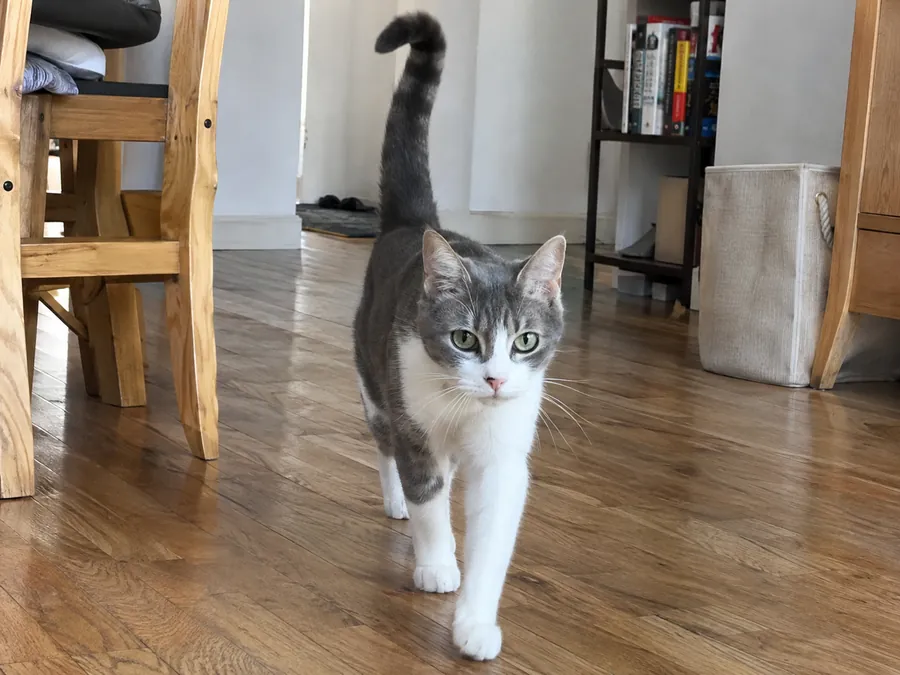
Cats talk mostly with their bodies. The ears, eyes, whiskers, tail and overall posture tell you whether your cat is relaxed, curious, nervous or ready to lash out, and the clearest reading always comes from several signals together, never from one.
This guide goes through each body part, adds the sounds that go with them, and finishes with a quick table and what to do when your cat looks unhappy.
No single cue is a verdict. International Cat Care notes that changes in the position or movement of the eyes, ears and mouth, along with the cat’s whole-body posture, are all significant. A tail held high on a cat with a loose body is a very different message from a tail held high on a cat with flattened ears.
Context matters too. A cat that crouches with wide pupils in the vet’s waiting room is telling you something different from the same cat crouched at a window, staring at a bird.
Ears
Ears are the most expressive part of a cat, and they swivel independently.
- Forward and upright: relaxed or interested. International Cat Care says relaxed cats tend to have their ears facing forward in the normal position.
- Swiveling: the cat is listening to what is around it. One ear back and one forward often means it is tracking two sounds at once.
- Turned sideways or slightly back: worried. The RSPCA describes a worried cat’s ears as slightly swiveled sideways.
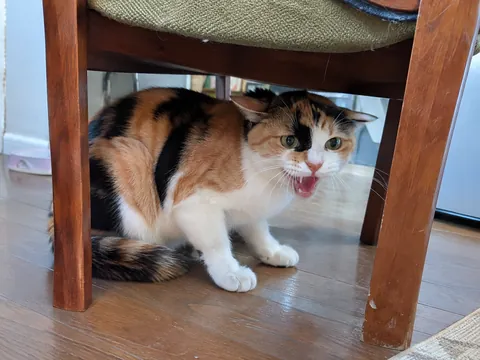
- Flat against the head (“airplane ears”): fear, irritation or anger. The Humane Society describes ears held backward, sideways or flat as irritable, angry or frightened, and says that when you see them, you should leave the cat alone.
Eyes, pupils and whiskers
Pupil size changes with light, so judge it in context. In normal lighting, a few patterns stand out.
- Soft, half-closed eyes and slow blinks: relaxed. If a cat looks at you and slowly closes and opens its eyes, Cats Protection says that signals relaxation, and you can slow-blink back.
- Wide pupils: International Cat Care says dilated pupils with ears flat against the head are often a sign of fear. Dilated pupils can also come with excited play, so look at the ears and tail too.
- Narrow pupils with erect, rotated-out ears: usually frustration, according to the same source.
- A hard stare with little blinking: antagonistic. Staring at other cats with wide eyes and little blinking occurs during tense meetings. Avoid staring back at a cat that does this.
Tail
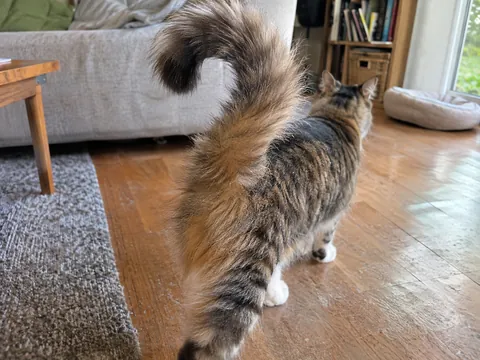
The tail works like a mood flag, and our full guide to cat tail language covers every position. The short version:
- Straight up, sometimes with a curl at the tip: happy, confident and glad to see you.
- Tucked under the body or between the legs: anxious or scared.
- Puffed up: scared or threatened, trying to look bigger.
- Slow side-to-side movement: undecided, frustrated or about to pounce.
- Quick lashing or twitching: agitation or anger. The faster the tail, the angrier the cat.
Whiskers move with mood. International Cat Care says that when a cat is tense or highly alert, the whiskers fan out and point forward in front of the face, and a frightened or nervous cat may flatten them against the side of its face. Relaxed whiskers sit in a neutral, sideways position.
Posture
Posture shows how confident a cat feels.
- Loose, relaxed body with smooth fur: content.
- Crouched, tense, head lowered: worried. The RSPCA lists a tense, crouched body and a lowered head, often with a retreat to a hiding spot.
- Back arched with fur standing up: frightened or angry. The Humane Society adds that an arched back with flat fur can instead mean the cat welcomes your touch, so check the fur.
- Head and neck pulled in: an anxious or fearful cat tries to look small.
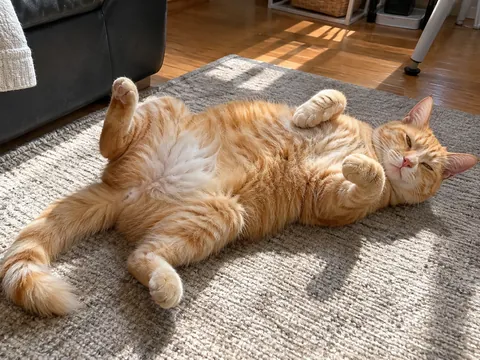
- Rolling over and showing the belly: trust, but not always an invitation to rub. Often it is just a relaxed cat who feels safe.
Sounds that go with the body
Sounds add detail but never replace the body signals.
- Meows are mostly aimed at people. Our guide to cat meow meanings explains the common types.
- Purring usually goes with contentment, but a cat in pain or stress can purr too.
- Hissing, spitting and growling are warnings. If you are seeing them, read why your cat hisses at you and give the cat room.
Quick reference table
| Signal | Relaxed or happy | Worried or fearful | Angry or ready to strike |
|---|---|---|---|
| Ears | Forward, natural position | Slightly sideways | Flat against the head |
| Eyes | Soft, slow blinks | Wide pupils | Hard stare, narrow or very wide pupils |
| Tail | Up, curved at the tip | Tucked tight to the body | Tense, thrashing or puffed |
| Whiskers | Neutral | Flattened to the face | Fanned forward |
| Posture | Loose, smooth fur | Crouched, head low | Arched or stiff, fur on end |
| Sound | Purr, chirp | Silent, hiding | Hiss, growl, yowl |
What to do when your cat looks unhappy
The ASPCA gives a rule of thumb for cats showing defensive postures: do not touch, try to reassure or punish them. The best way to handle a defensively aggressive cat is often to avoid it until it calms down.
- Stop what you are doing and move away calmly.
- Give an escape route. Fearful cats escalate when they cannot get away.
- Let the cat hide in its favorite spot. The RSPCA notes this helps a worried cat feel safe.
- Never punish. It does not teach anything useful and makes fear worse.
- Try again later with a calm voice and a slow blink.
If you like to practice, you can photograph your cat in a relaxed moment and compare it with what you have read here. The Mood photo feature in Cat Translator gives a playful guess from posture, which is a fun way to start noticing details, though it is for entertainment only. For ideas on happier signals, see how to tell if your cat is happy.
When to call your vet
A sudden change in how your cat carries itself can be a sign of pain or illness rather than mood. The VCA says that growling or hissing when approached by family members, hiding, withdrawal from usual interactions, changes in eating and drinking, and changes in grooming or litter box habits can all be signs of pain.
Call your vet if you notice a new or lasting change like these, or if a normally friendly cat starts swatting or avoiding touch. The ASPCA also stresses that a medical check is essential for cats showing aggression.
Sources
- International Cat Care — Cat communication
- RSPCA — Cat body language
- Humane World for Animals — Understanding cat behavior and feline language
- ASPCA — Aggression in Cats
- Cats Protection — Cat tail meanings
- VCA Animal Hospitals — How do I know if my cat is in pain?
Cat Translator is an entertainment app. This article is general information, not veterinary advice. If your cat's behavior changes suddenly, talk to your vet.