Why does my cat chirp at me?
Why does my cat chirp at me? Chirps and trills are usually friendly greetings or excitement, and sometimes a request. Learn how chirping differs from chatter.
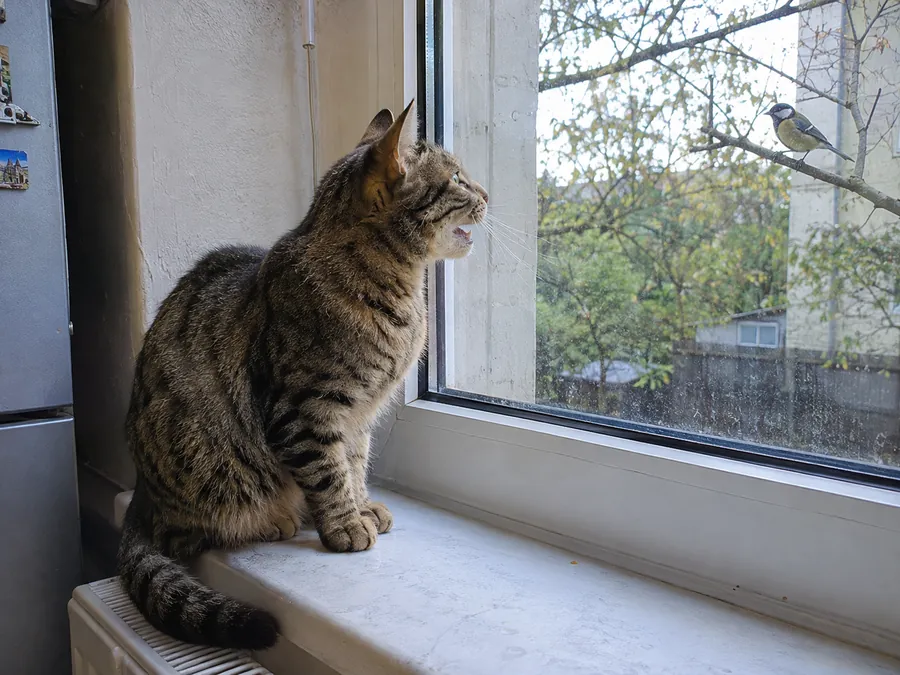
A cat who chirps at you is usually being friendly. Chirps and trills are soft, higher sounds cats use to greet people, show excitement, or point you toward something they want. They are different from meows, and different again from the clicking chatter cats make at birds. Context tells you which one you are hearing.
This guide covers what each sound is, the main reasons your cat chirps at you, how to respond, and the rare cases where a change is worth a vet visit.
Chirp, trill, chatter: three different sounds
Trill or chirrup. A short, soft, rolling sound that rises in pitch, a bit like a purr that learned to talk. International Cat Care describes the “trill” or “chirrup” as a friendly greeting call, sometimes directed at people.
Chirp. A short, higher-pitched sound. VCA says cats chirp when they are excited, happy, or have something to show you, and that mother cats make the sound to get their kittens’ attention.
Chatter. A rapid clicking of the jaw, often with a quivering mouth. Cats Protection says chattering could be a display of excitement, or caused by a surge of adrenaline from seeing prey they want to catch but cannot reach, or by frustration at not being able to catch it. VCA adds that cats will sometimes chatter at birds or other critters they are watching outside a window.
Owners tend to use the words loosely, and the sounds do overlap. What matters is the situation.
Why your cat chirps at you
A greeting
This is the most common reason. A study of cat vocalizations other than meowing reports that the trill has already been described in the context of cats approaching familiar people in a friendly way. It often happens when you come home, walk into the room or appear at the door in the morning. Expect a raised tail and maybe a head bump or a few circles around your legs.
Excitement
VCA says cats chirp when they are excited or happy. A cat who chirps as you reach for the wand toy, open the treat cupboard or sit at the window is looking forward to something.
“Follow me”
Cats also chirp when they have something to show you, as VCA puts it. Many owners know the pattern: a chirp, a look back, a few steps ahead, then a stop. She may be leading you to the food bowl, to a toy, or just to where she wants you to be. It echoes how mother cats call their kittens.
A request
Chirping can slide into asking. Chirps at the bowl or the treat spot are food requests. Chirps with a head bump or a leap onto your lap are requests for attention. Cats learn what gets results, and people tend to reward chirps with a smile, which makes the habit stick. International Cat Care notes that people often reinforce cat sounds, which helps shape them.
Hunting excitement
A cat who chirps while stalking a toy or watching a bird is in hunting mode. Cats Protection says nobody knows for certain why cats chirp and chatter at birds and other wildlife. One theory is that the cat may be trying to mimic its prey. Another is that it is frustration at not being able to catch it. The article calls the idea that the jaw movement mimics the killing bite unlikely.
Why some cats chirp and others never do
Not every cat makes these sounds. Some chirp at everything and some seem to skip the sound entirely, much as some cats purr loudly and others are nearly silent. Early life, the household and personality all play a part, and a cat who never chirps is not missing anything. She is probably greeting you in other ways, such as a head bump, a raised tail, a slow blink or simply showing up wherever you are.
It also helps to remember that the sounds blur together. The same cat may trill at the door, chirp at a toy and chatter at the window within an hour. You do not need to label each one. Watching what happens next is more useful than finding the right word.
How to tell what she means
You can narrow it down quickly:
- Home or door? A greeting.
- Near the bowl or treats? A request for food.
- Looking at a bird or a bug? Excitement or frustration.
- Chirp, glance, walk away? An invitation to follow.
- Chirp plus head bump and relaxed body? Affection or a request for attention.
No one can know exactly what a cat means. But after a week of noticing, most owners learn their own cat’s patterns quickly.
How to respond
Chirp back, if you like
Talking back in a soft voice is fine and many cats enjoy it. You are not teaching her anything harmful. If she is greeting you, a quiet hello, a slow blink and a pet if she wants one is a good reply.
Offer play for hunting chirps
Cats Protection recommends regular short play sessions every day to satisfy hunting instincts. A wand toy with a bit of stalking and a final “catch” works well. If she chatters at the window, ten minutes of play before the birds are out helps. For a quick bit of movement on a busy day, a free browser laser game gives her something to chase.
Do not reward constant requests
If her chirps are always about food, feed at fixed times so the habit does not become “chirp and the bowl fills.” The same advice applies to meowing, which we cover in why cats meow at you.
Skip the punishment
Chirping is a friendly sound. There is nothing to stop. If it becomes too much, give attention when she is quiet and use play and routine to meet the need.
If you like trying new things with your cat, the Cat Translator app has games for cats and a Talk back feature that plays a cat sound for a phrase you type. It is just for fun.
When to see a vet
Chirps and trills are normal. Cats Protection says that if chattering is new for your cat, or happening much more than usual, a vet should check for a medical reason. The same is sensible for chirping. Call if:
- A new pattern of chirping, chattering or other vocalizing has appeared suddenly
- It comes with restlessness, confusion or wandering, especially in an older cat
- She is eating, drinking or using the litter box differently
- She seems distressed, hides, or cries out while moving or using the litter box
VCA recommends a veterinary examination to rule out medical causes of unusual vocalizing in middle-aged and older cats, such as pain, endocrine problems or high blood pressure. For the full range of sounds, our guide to cat meow meanings is a good next read.
The short version
If your cat chirps at you, she is almost certainly happy to see you, excited, or asking for something. Notice the setting and her body, answer kindly, and give her play to burn off hunting energy. A sudden change in how she sounds is the only time to worry.
Sources
- International Cat Care — Cat Communication
- Fermo et al. — Only When It Feels Good: Specific Cat Vocalizations Other Than Meowing (Animals, 2019)
- VCA Animal Hospitals — 10 Weird Sounds Pets Make (and How to Interpret Them)
- Cats Protection — Why do cats chatter and chirp at birds?
- VCA Animal Hospitals — Cat Behavior Problems: Vocalization
Cat Translator is an entertainment app. This article is general information, not veterinary advice. If your cat's behavior changes suddenly, talk to your vet.