Why does my cat sleep at my feet?
Cats sleep at your feet for warmth, safety and closeness without crowding you. Here is what the spot means and when a change is worth a closer look.
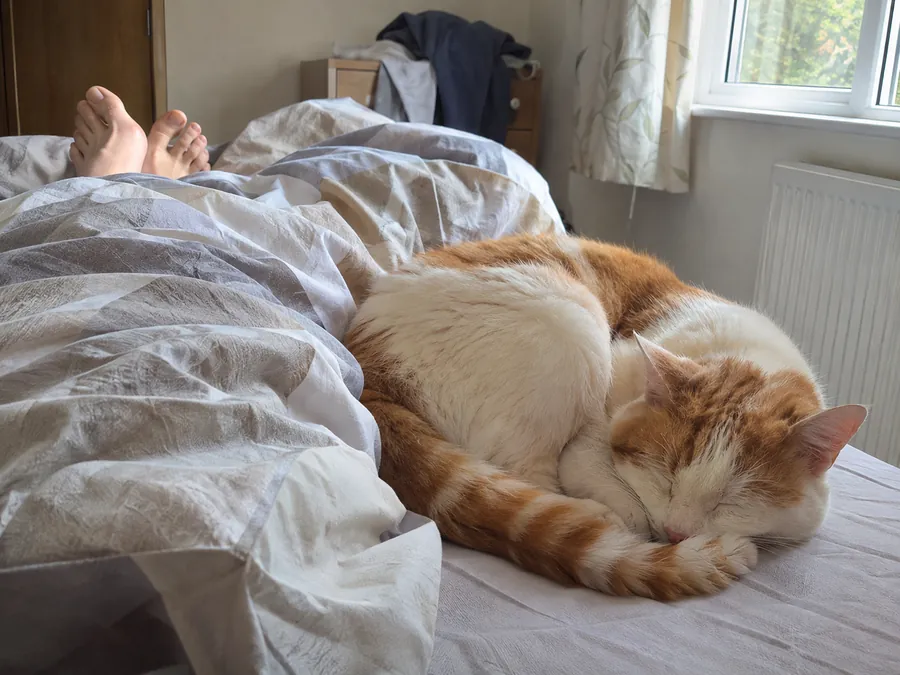
Most cats sleep at your feet because it gives them warmth and company with an easy exit. The foot of the bed or sofa is close enough to feel safe near you, but far enough that nobody is crowded.
This article explains the six main reasons behind the habit, how it differs from a cat who sleeps on your chest, and when a change in where your cat sleeps is worth mentioning to a vet.
The short version
Your cat is picking the spot that checks the most boxes at once: warm, soft, safe and near their person. Your feet happen to do all four. It is a compliment, and it is also practical.
The reasons, one by one
1. Warmth
Cats prefer warm places to sleep, according to International Cat Care. A bed covered in a duvet, with a human-shaped heater under it, is about as good as it gets. Feet and legs under blankets hold heat for hours.
VCA Animal Hospitals notes that one theory behind circling and curling up is that cats tuck their bodies tightly to conserve body heat. Your feet give them a head start on that.
2. Feeling safe
Wild cats have no pack to keep watch while they sleep, and VCA points out that our pampered pets still carry the instincts of lone hunters. Sleeping is the moment a cat is most vulnerable, so the choice of spot matters.
International Cat Care says many cats feel vulnerable sleeping on the floor and often prefer a raised spot. Your bed or sofa is raised, and the person next to it is a reliable early warning system. The foot end also keeps a clear path to the door.
3. Closeness without crowding
A cat at your feet has company but keeps some personal space. This suits cats who like to be near you without being held, and cats who get warm or restless if they are pressed against a body all night.
VCA’s guide to sleeping positions describes snuggled-up sleeping as a sign of craving love and connection. A spot at your feet is a quieter version of the same message: I want to be where you are.
4. A familiar scent
International Cat Care notes that many cats want the familiar scent of themselves and their home where they sleep. Your bed smells strongly of you, and the foot end smells of your clothes, your skin and your cat. That combination tells a cat the spot is safe and belongs to the family.
5. A steady, still spot
Feet do not move much once you fall asleep. A leg that shifts a little every few minutes is harder to sleep against than a pair of feet under a blanket. Cats tend to choose places that are stable, especially for long naps, and cats can sleep for many hours a day. VCA says anywhere from 12 to 16 hours.
6. Habit and routine
Cats love routine. If your cat slept at your feet three nights in a row, the spot quickly becomes theirs. Cats repeat what has worked before, and if you ever reward the habit with a gentle word, it becomes even more fixed.
Sleeping at your feet versus other spots
| Spot | What it often means |
|---|---|
| At or on your feet | Warmth and company with some personal space |
| Against your legs or hip | Wants more contact, still flexible |
| On your chest or by your head | Wants maximum closeness and warmth; see why cats sleep on your chest |
| Across the room | Prefers distance tonight, or the room is too warm |
None of these ranks how much your cat loves you. Treat the pattern as information about their comfort.
What to do if your cat’s spot is a problem
A cat at your feet is rarely a problem, but a few things can make it more comfortable for both of you.
- Give your cat their own warm spot at the foot of the bed, such as a folded blanket, so they stay put if you shift.
- Do not pull your feet away sharply. Slow, small movements keep a sleeping cat from startling and using claws.
- Keep claws trimmed if your cat kneads your feet through the blanket. Our guide to why cats knead explains that habit.
- Try a cat bed beside you if you share the bed with someone who does not enjoy a cat on their legs.
- Play before bedtime so your cat is relaxed instead of restless. If your cat is bored in general, this guide has ideas.
Making the foot of the bed work for both of you
Once you know why your cat picks that spot, you can shape it. Cats do not need a perfect set-up, only a place that feels warm, steady and theirs.
Start with the surface. A folded fleece or a soft throw at the foot of the bed gives your cat a defined spot, and it carries their scent, which International Cat Care says many cats want where they sleep. Wash it now and then, but not every day, so it keeps smelling like home.
Think about temperature next. Cats like warmth, but a cat who shifts around or pants in a hot room may want a cooler spot. Leave a second option nearby, such as a bed on the floor or a chair, so your cat can choose.
Finally, think about sleep. Cats are most active at dawn and dusk, so a cat at your feet may wake you early. A play session and a small meal in the evening often helps. If your cat wakes you up by meowing, read why cats meow at night for more ideas.
When to call your vet
Where your cat sleeps is a good window into how they feel. Mention it to your vet if the change lasts more than a few days or comes with other signs:
- Your cat suddenly stops sleeping near you, or starts hiding in places they never used to.
- They seem stiff or hesitate to jump onto the bed, which can mean joint discomfort.
- Appetite, drinking or litter box habits change at the same time.
- They seem restless or cannot settle at night.
A vet is the right person to look at any of these. Do not guess at the cause yourself.
The bottom line
A cat who sleeps at your feet is warm, safe and where they want to be. If you would like to learn more about what your cat is telling you, our cat body language guide covers the rest of the signals, and a free laser game for cats is a good way to burn off energy before bed.
Sources
- International Cat Care — Making your home cat friendly
- VCA Animal Hospitals — Why Cats Turn Around Before Lying Down
- VCA Animal Hospitals — Why do cats sleep in weird places?
- VCA Animal Hospitals — Cat sleeping positions decoded
Cat Translator is an entertainment app. This article is general information, not veterinary advice. If your cat's behavior changes suddenly, talk to your vet.